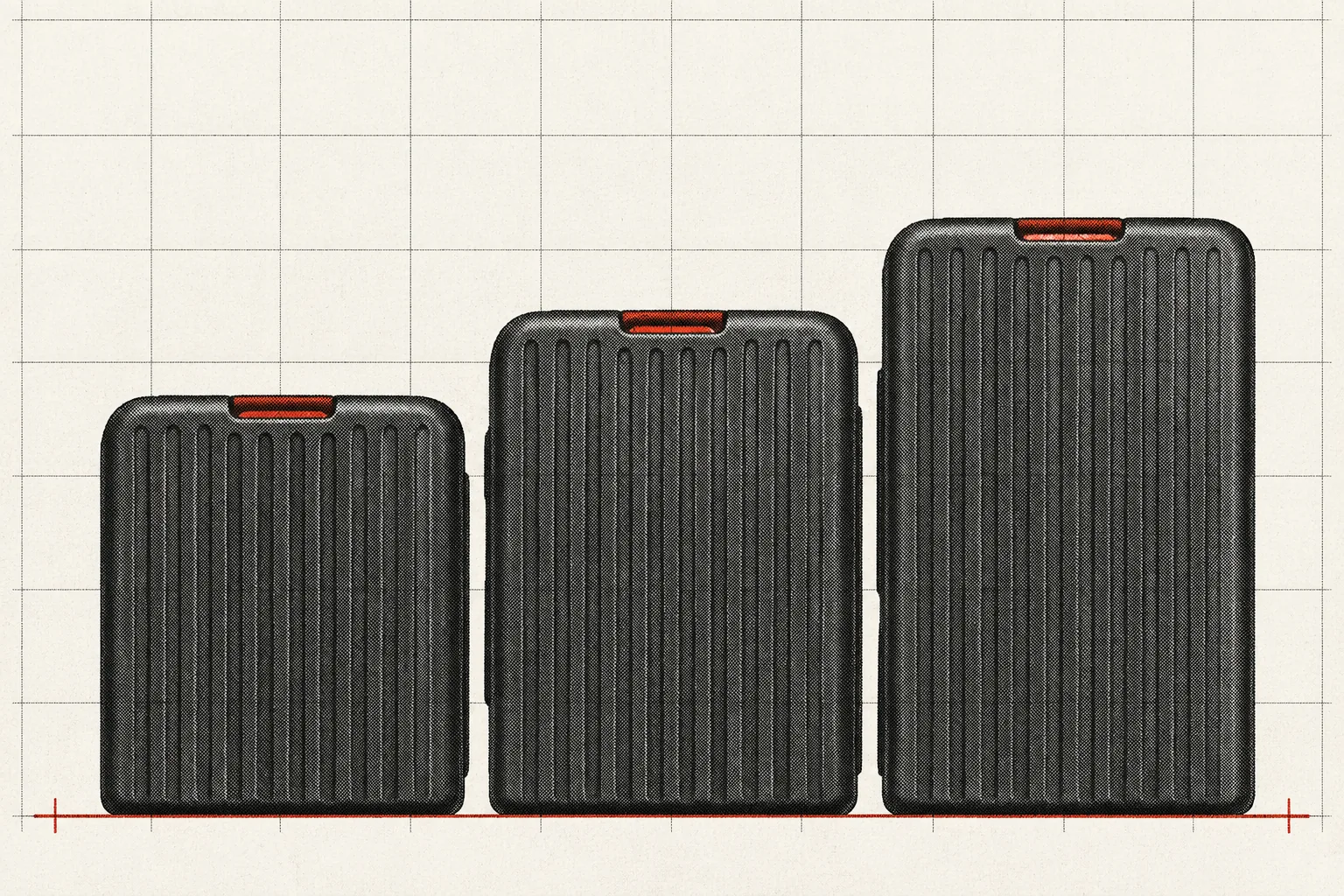
Suitcase Size to Liters Conversion: Typical Capacity by Height
Selecting luggage based solely on external height often leads to packing errors. Suitcase volume is measured in liters, reflecting the internal three-dimensional space available for gear rather than overall exterior dimensions. External shell measurements include corner curves, clearance profiles, and structural tapers that do not translate into usable storage. Understanding standard height-to-liter conversions provides an immediate baseline for trip planning and production sizing.
| Suitcase Height (Inches / mm) | Standard Category | Typical Packing Capacity (Liters) | Standard Trip Duration |
|---|---|---|---|
| 20" (500–550 mm) | Cabin / Carry-on | 35–45 L | 1–4 days |
| 24" (600–660 mm) | Medium Check-in | 60–75 L | 5–9 days |
| 28" (700–760 mm) | Large Check-in | 90–110 L | 10–14 days |
| 32" (800–850 mm) | Extra-Large Check-in | 120–140 L | 15+ days / Extended transit |
These liter ranges represent industry-wide averages for conventional hardshell and softshell luggage profiles. However, generic exterior dimensions never provide an exact volume calculation. For brand owners and procurement teams, usable interior capacity varies significantly based on wall thickness, wheel housing intrusion, and shell curvature. Actual interior liter specifications for production runs are confirmed directly on technical engineering sheets prior to tooling or mass assembly.
Calculating True Usable Suitcase Volume from Internal Dimensions
Suitcase capacity is frequently miscalculated by measuring external boundaries. Multiplying exterior length, width, and height and dividing by 1,000 provides external envelope volume in liters, but this measurement includes caster wheels, grab handles, and protective bumpers. In practical applications, relying on external dimensions overstates true packing capacity by 15% to 25%, depending on the chassis configuration and wheel mount design.
To determine gross internal volume, measurements must be taken from the inside walls: internal length multiplied by internal width and internal depth in centimeters, divided by 1,000. However, gross internal volume does not represent net packing space. Hardware integration creates unavoidable displacement within the luggage shell:
- Trolley handle housings: Internal dual-tube or mono-tube aluminum channels protrude into the floor of the base shell, deducting 1.5 to 3.5 liters of packing space.
- Wheel well assemblies: Recessed spinner wheel blocks displace room in the lower corners of the shell.
- Linings and divider systems: Internal foam padding, mesh organizers, zipper tracks, and compression boards reduce functional clearance.
Because structural hardware directly dictates interior yield, generalized formulas serve only as initial estimates. Factory-certified interior volumes are confirmed per order on technical specification sheets, utilizing CAD 3D boundary modeling to calculate exact usable displacement based on the specific shell profile, internal ribbing, and hardware package selected.
Why Internal Hardware and Shell Contours Reduce Usable Liter Capacity
Calculating luggage capacity by multiplying maximum exterior dimensions (length × width × depth) yields a gross theoretical volume that overstates actual packing space. In injection-molded polypropylene (PP) and thermoformed PC/ABS manufacturing, outer dimensions include structural corner radii, draft angles required for tool release, and exterior reinforcement ribs. These architectural contours maintain shell rigidity under load—such as our benchmark static tests of 40 kg on 535–660 mm shells and 60 kg on 685–835 mm shells for four hours—but they reduce the true internal rectangular cube.
Internal mechanical assemblies cause the most substantial volume displacement. The recessed housing channels for multi-stage aluminum trolley systems run along the back wall of the base shell, creating raised longitudinal ridges that bisect packing space. Similarly, recessed corner wheel wells engineered to protect 360-degree dual caster assemblies intrude directly into the lower storage floor. Perimeter closures also consume clearance: internal gasket channels for aluminum-frame designs and fabric tape margins for reverse-coil zippers occupy perimeter space that cannot be packed.
Because hardware profiles, handle nesting depths, and shell curvatures differ across tooling designs, theoretical geometry cannot determine practical capacity. For procurement evaluations and custom OEM tooling projects, exact net interior liter ratings are not assumed from exterior shell measurements; they are measured and confirmed per order on individual technical specification sheets.
Packing Cubes and Trip Duration: Translating Volume into Usable Cargo
Luggage capacity in liters translates directly to the volume of clothing and gear a traveler can pack, commonly measured by travel days and standard packing cube modules. A standard medium packing cube holds approximately 8 to 10 liters of compressed clothing. A 35 to 45-liter carry-on accommodates two to three medium packing cubes alongside a slim toiletry pouch and a spare pair of flat shoes, providing adequate space for a 2-to-4-day trip. Medium checked luggage, ranging from 60 to 75 liters, fits four to six packing cubes and accommodates secondary footwear and heavier garments suited for a 7-to-10-day itinerary. Large checked luggage spanning 90 to 110 liters or more provides enough capacity for two or more weeks of travel, bulky cold-weather gear, or consolidated multi-person packing.
Achieving these calculated packing loads depends heavily on internal shell geometry. In conventional two-compartment clamshell designs, half of the internal volume is interrupted by the recessed aluminum trolley handle tubes. Standard rectangular packing cubes lay flat against the unobstructed side of the case, whereas the side housing the handle chassis requires softer, flexible items or specialized slim cubes to fill the valleys between the structural ribs without wasting usable volume.
Because external shell measurements calculate total exterior displacement rather than functional internal space, raw dimensions overstate true packing volume by 10 to 20 percent. Frame hardware, lining clearances, wheel housings, and internal divider panels all subtract from net cargo room. For commercial product development and inventory planning, exact internal liter ratings must be verified per model on technical specification sheets rather than derived from outer casing dimensions.
Specifying Usable Volume and Engineering Tolerances for OEM Luggage
Calculating luggage capacity solely by multiplying exterior length, width, and depth produces a gross displacement figure that misrepresents actual packing room. In custom manufacturing, usable interior volume is reduced by internal wheel housings, corner reinforcement curvature, and the recessed channel housing the multi-stage trolley handle system. For commercial buyers and brand owners, technical specification sheets must isolate net functional volume from gross exterior dimensions to prevent misleading consumer claims and airline sizing discrepancies.
At PT DJI Travel Products Indonesia, shell geometry and dimensional tolerances are established using 100% in-house mould making and two 1,500-tonne injection machines at our 10,000 m² Kemang, Bogor facility. Because interior capacity changes depending on whether the shell is formed from PP, PC/ABS, or engineered with an aluminum frame, we do not apply generalized liter ratings across production runs. Instead, exact usable interior volumes, compartment depth splits, and component clearances are measured and verified per order on formal technical specification sheets.
Volume tolerances must also correlate with mechanical load limits. Our production line benchmarks verify structural integrity relative to intended packing loads via continuous static load pressure testing: 535–660 mm shells must withstand 40 kg of continuous static pressure for 4 hours, while 685–835 mm shells are tested under 60 kg for 4 hours without shell buckling or frame distortion. These volume and structural parameters are finalized during the sample turnaround of 7–15 working days or within the ~80-day custom mould project cycle (comprising 10 days tooling, 25 days transit, and 45 days mass production), preceding our standard 25–55 days mass production schedule.