Who Sources Beauty Cases in Volume: Four Buyer Segments and One Shared Challenge
Beauty cases carry different demands than checked luggage. The shell must protect glass bottles and powder compacts during handling, but the empty weight must stay low enough for a makeup artist to carry it up three flights of stairs. Interior fittings—trays, elastic loops, brush dividers, mirrors—define the product more than the shell itself, yet most luggage factories treat them as afterthoughts. Buyers in four segments face the same problem: finding a manufacturer that approaches beauty cases as a distinct product category rather than a smaller suitcase.
Salon and beauty academy chains order cases as student kits or branded retail inventory. Hotel groups specify in-room vanity cases for suites and long-stay properties, where the case must carry a logo, match interior design palettes, and survive housekeeping handling. Importers and distributors supply the professional makeup artist market, where a case is a working tool rather than occasional-use luggage. Private label brands—particularly those with an existing bag or luggage line—add a beauty case to extend category coverage and increase average order value.
All four segments need the same three things: a factory that fabricates moulds in-house so shell dimensions and interior layouts can be built to specification rather than chosen from a fixed catalogue; production infrastructure capable of both hard-shell injection and soft-goods assembly for trays and pockets; and an MOQ structure that allows multiple SKUs in a single order without requiring 1,000 units per colour.
Aluminum-Frame vs ABS Hard-Shell Beauty Cases: Matching Construction to Sales Channel
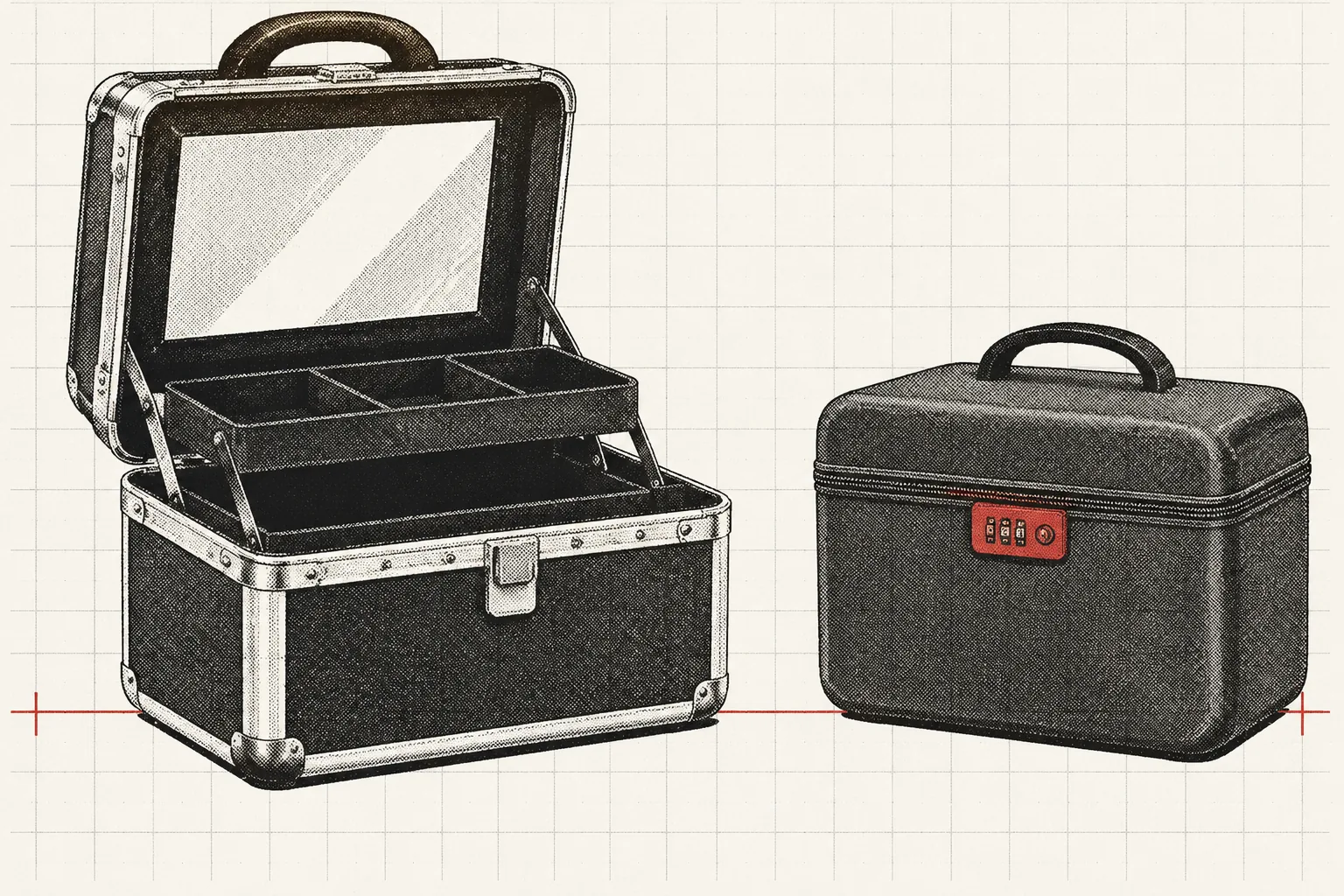
Aluminum-frame beauty cases join two deep ABS or PC half-shells with an exposed 5052 or 6061 aluminum perimeter frame and corner protectors. The frame absorbs lateral impact and the metal finish signals durability to the end user. Full ABS or ABS+PC monoshell cases use a zippered hard shell with no external frame; the profile is lighter and the exterior accepts full-surface printing or embossing. Both constructions share the same wheel, handle and hardware test protocols used for upright luggage, including the 8 km drum wear test, 600-cycle trolley reciprocation and 900 mm drop onto steel plate.
Aluminum-frame cases suit hotel in-room programs and salon retail where the metal trim reinforces a premium positioning and the case will be handled by multiple users over several years. The frame adds 15-20 percent to empty weight compared to a zippered ABS shell of the same exterior dimension, but the rigidity protects fragile interior fittings during transport. ABS monoshell cases suit private-label importers targeting makeup artists and mobile beauticians, where lower unit weight and lower tooling cost for a simpler mould support higher margin and portability. Salon academies ordering staff kits in matching livery often choose ABS for the larger printable surface.
Exterior dimensions, panel thickness, empty weight and interior tray layout are built to the client's drawing and confirmed per order. Acceptance criteria for mirrors, dividers and elastic loops are agreed in writing per order because no beauty-case-specific test standard exists in the factory's current protocol library. The 100-piece MOQ per SKU applies to each colour and size combination.
Interior Configuration Drives the Specification
Unlike luggage production where shell size and wheel configuration form the primary specification, beauty case manufacturing begins with the interior layout. Tray count, divider placement, mirror size and attachment method, and closure hardware are agreed in writing per order. PT DJI Travel Products does not maintain a beauty-case catalogue; each project is built to the client's drawing or prototype, with dimensions, wall thickness, empty weight and litre capacity confirmed during the sampling phase.
Interior fittings—removable trays, fixed dividers, elastic loops, brush holders and framed mirrors—are fabricated from the same material palette as the shell or specified separately. ABS and polypropylene trays can be injection-moulded in-house using the two 1,500-tonne machines in the Bogor plant; aluminium trays and frames are cut and anodised to match the case perimeter. Acceptance criteria for flatness, edge finish and mirror retention are documented per order, since no universal test standard for beauty-case interiors exists in the way that wheel-assembly or drop-test protocols govern luggage shells.
Lock configuration follows the same principle. TSA-approved combination locks are standard on hardshell models that carry a lock, but zipper-closure beauty cases typically carry zero locks, and the count varies with frame design. Buyers specifying hotel vanity cases or salon inventory should submit both exterior dimensions and a tray layout diagram during the inquiry phase, so that tooling scope, material quantities and unit cost are calculated from a complete specification rather than a shell outline alone.
Testing and Quality Control for Beauty Cases: Which Luggage Benchmarks Transfer and Which Do Not
Beauty cases share structural components with wheeled luggage—shells, trolley handles, wheel assemblies, hardware—so most mechanical tests transfer directly. At the Bogor plant, hard-shell beauty cases undergo the same wheel durability protocol as suitcases: 8 km on a concrete drum, 2 km on a ribbed belt, and 2 km across an obstacle belt, with wear held at or below 2 mm. Trolley handles face 600 reciprocating cycles at 30 cycles per minute plus 5,000 lifting shock cycles. Zippers complete 500 reciprocating cycles at a 75 mm stroke and 30 cycles per minute under JIS S 3015:2019. Hardware receives a 16-hour neutral salt spray exposure per ISO 9227 and ASTM B117, with corrosion spots limited to grade 3 and total area below 1 mm². Drop tests release the case from 900 mm onto a solid carbon steel impact plate at 18–25°C, and a second drop occurs at -12°C after four hours of cold conditioning at 90 cm height. Aluminium frame anodising achieves a 10–12 micrometre film thickness, and shell opening hardness meets or exceeds 40 HWB under ISO 6506 or ASTM E10.
Interior fittings—trays, dividers, mirrors, elastic loops—have no equivalent luggage test standard. Acceptance criteria for these components are agreed in writing per order. Buyers typically specify tray deflection limits under load, mirror adhesion pull force, and elastic retention after repeated stretching. Inspection covers incoming material control, in-process checks, and final AQL sampling, but the pass/fail thresholds for beauty-case interiors must be defined by the client and documented before mass production begins.
Building a Beauty Case Quote: Drawings, MOQ and Timeline
Because DJI manufactures beauty case moulds in-house rather than working from a fixed catalogue, every inquiry begins with a technical drawing or physical sample. The quotation requires shell dimensions, wall thickness, interior tray layout, handle type, lock specification, and finish—anodised aluminium, textured ABS, or polycarbonate. Buyers should also indicate whether mirrors, elastic bands or removable dividers are part of the interior. Where these details are not yet finalised, the factory can propose a layout based on the intended use case, but the final price depends on the agreed bill of materials.
The minimum order quantity is 100 pieces per SKU, where SKU means one combination of size and colour. A program with two sizes in three colours requires 600 pieces total. Tooling cost for a new shell shape is absorbed into unit pricing or quoted separately depending on order volume; confirm this in writing before deposit. Sampling takes 7–15 working days once the drawing is approved. Mass production runs 25–55 days after sample sign-off. If new tooling is required, add approximately 35 days for mould fabrication and shipping, bringing the total timeline to around 80 days from drawing freeze to cargo-ready date.
Payment terms follow a 30 percent deposit against proforma invoice and 70 percent balance against shipping documents. Other trade terms—including deferred payment, consignment or letter of credit—are confirmed per order and depend on the buyer's incorporation and credit profile.