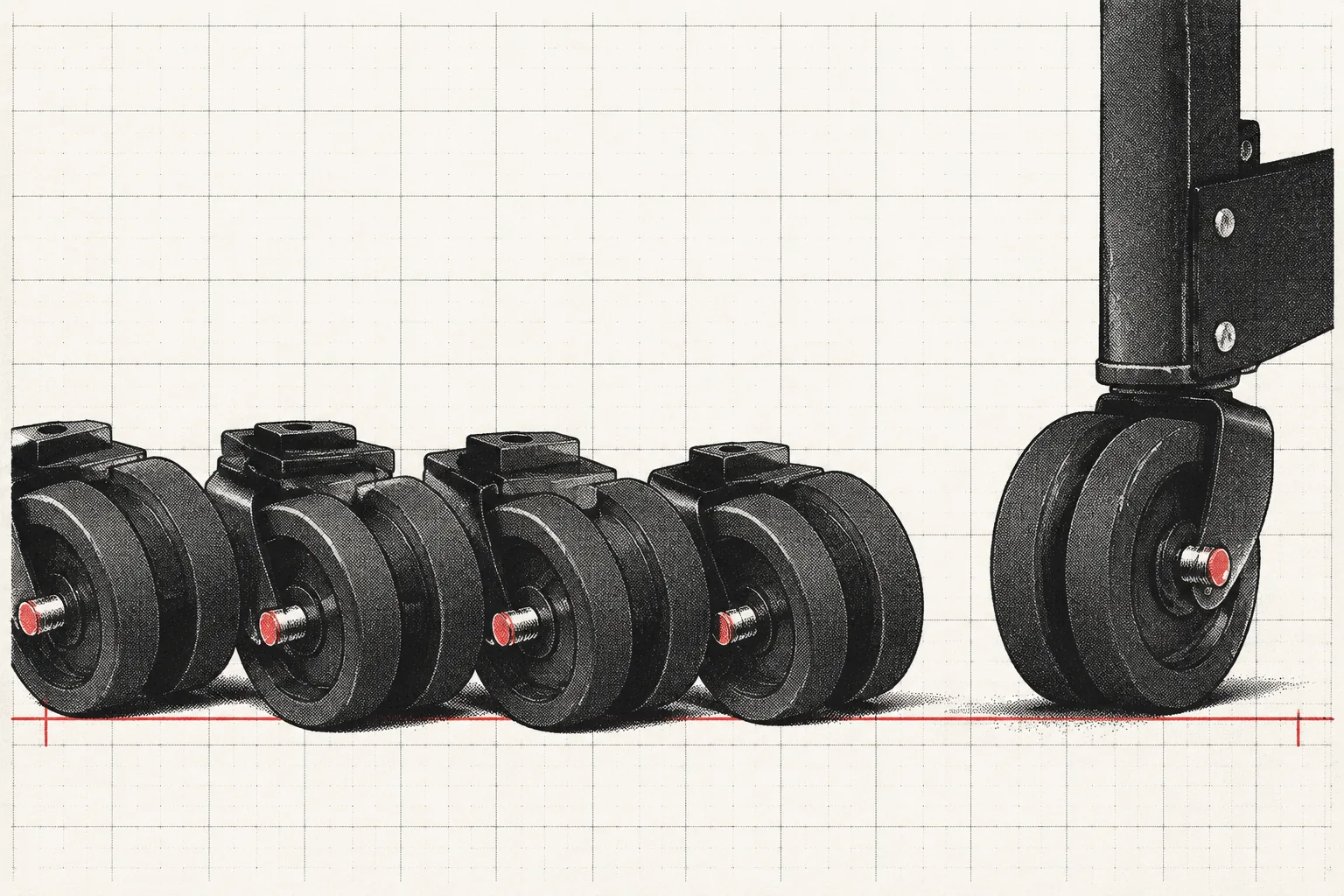
Standard Component Buffer Allocations for Wheels, Trolleys, and Locks
Servicing aftermarket warranty claims via air freight or isolated LCL sea shipments severely erodes product margins. When a customer reports a damaged caster, jammed telescoping tube, or cracked lock mechanism, sourcing replacements on demand introduces excessive freight surcharges, import clearance delays, and stockout friction. Incorporating a dedicated spare parts buffer ratio directly into the initial production run is the most cost-effective safeguard for maintaining domestic service levels.
Hardware buffer requirements vary according to the component's mechanical exposure during transit and daily handling:
- Spinner Wheels: As the primary point of ground contact absorbing continuous rotational friction and multi-angle impacts, dual-wheel assemblies generally require an allocation buffer of 2% to 3% of the total order volume per SKU.
- Telescopic Trolley Systems: Subjected to repetitive extension and directional torque, trolley handles require a recommended allocation of 1% to 1.5% to service handle grip failures or bent extrusion tubes.
- TSA Locks and Top/Side Carry Handles: Because these hardware components experience static loads rather than rolling impact, a 0.5% to 1% buffer ratio is standard for handling incidental transit damage.
These ratios align with standard one-year commercial warranty obligations, though allocations should scale upward for programs servicing heavy-utilization environments such as frequent-flyer corporate accounts or guided travel groups. Spare hardware components are packed into separate bulk master cartons rather than packed inside finished luggage shells; exact carton dimensions and total packaging CBM for allocated spares must be confirmed per order based on the final SKU hardware matrix.
Component Wear Profiles and Testing Benchmarks Determining Buffer Needs
Calculating an accurate luggage spare parts buffer ratio requires examining how individual components degrade under physical stress. Mechanical hardware experiences divergent failure rates across retail and travel lifecycles. High-impact moving elements—principally caster assemblies, telescoping trolley systems, and pull handles—absorb the majority of transit abuse and account for the highest volume of post-sale warranty claims, requiring larger buffer reserves than static structural fittings.
Component testing benchmarks establish baseline longevity parameters before mass manufacturing. Quality control protocols evaluate 4-wheel assemblies across an 8 km concrete drum, a 2 km ribbed belt, and a 2 km obstacle belt, demanding total tire wear not exceed 2 mm, alongside a loaded 25-step drop test at a 200 mm step height. Telescoping trolley handles undergo 600 reciprocating cycles at 30 cycles per minute and 5,000 handle-lifting shock cycles without structural detachment or permanent deformation. Drop impact durability is validated at a 900 mm drop height onto a solid carbon steel impact plate, complemented by a low-temperature drop test following a 4-hour conditioning phase at -12°C.
Secondary components present distinct degradation curves. Zipper mechanisms must withstand 500 reciprocating cycles over a 75 mm stroke at 30 cycles per minute under JIS S 3015:2019 without burst or puller separation. Surface hardware complies with a 16-hour neutral salt spray test under ISO 9227 and ASTM B117 standards, restricting surface oxidization to three or fewer corrosion spots under 1 mm². Aligning pre-allocated spare part quantities with these empirical stress thresholds allows warranty teams to match component reserves directly against verified failure vectors.
Master Carton Packing vs. Internal Shell Nesting for Spare Parts
When consolidating warranty spare parts into full container load (FCL) shipments, procurement teams typically choose between packing components into dedicated master cartons or nesting them directly inside the finished luggage shells. Selecting the right method prevents separate less-than-container-load (LCL) freight charges and reduces warehouse handling friction upon arrival.
Dedicated master cartons offer straightforward logistics management. Hardware components—such as wheel assemblies, TSA lock mechanisms, and trolley handle sets—are sorted, bagged, and boxed by SKU with standard outer carton markings. This simplifies receiving, barcoding, and racking at your regional distribution center. However, master cartons occupy container cubic volume that would otherwise hold finished goods. Because exterior dimensions and weight vary significantly depending on the component mix, specific spare part master carton dimensions and exact CBM must be confirmed per order during final packing layout planning.
Internal shell nesting utilizes the vacant void space inside finished hardshell cases. Smaller replacement components, such as caster wheels or zipper pullers, are packed in sealed polyethylene bags and placed within the zippered internal lining dividers of the suitcases. This method eliminates the freight footprint of your warranty buffer, allowing you to maximize container capacity on high-volume runs. The trade-off is receiving labor: destination warehouse personnel must open nested units to retrieve spare inventory before dispatching finished stock to retail or fulfillment channels.
Calculating CBM and Payload Overhead for Spare Part Shipments
Integrating warranty replacement hardware directly into standard 40HQ container shipments eliminates standalone LCL sea freight minimum charges and costly air freight consignments. However, procurement teams must evaluate volumetric displacement and payload thresholds when consolidating loose or bulk-boxed components alongside finished PC/ABS or polypropylene luggage.
Component packaging methods directly dictate spatial impact within the container layout. High-turnover maintenance components—such as spinner wheel sets, telescopic trolley assemblies, and TSA locks—can either be pre-packed into designated finished cases or packed into separate corrugated master cartons placed in remaining container headspace. Because hardware dimensions and packaging densities vary across custom designs, specific spare part master carton dimensions, gross weights, and exact CBM figures are confirmed per order during pre-shipment packing planning.
Factoring component cube utilization early within the 25–55 day mass production cycle prevents unexpected container overflows at port dispatch. Incorporating a typical component buffer of 1% to 3% per SKU represents minor cubic displacement, securing domestic after-sales stock while preserving the freight efficiency of full container loads departing our Bogor plant.
Contractual Buffer Allocation: Factory Warranty Terms Versus Paid Component Overages
Factory warranty coverage operates in principle for one year, with terms customizable based on client commercial agreements. While this baseline framework guarantees structural integrity against factory defects, relying on post-claim component dispatches introduces costly international LCL shipping fees and customs clearance delays. For brand supply chain teams, defining contractual hardware buffer allocations during initial purchase order negotiations ensures regional service centers maintain immediate repair capability without emergency air freight expenses.
Procurement contracts should formally distinguish between free-of-charge (FOC) warranty provisions and supplementary paid component inventories. While standard warranty allowances address immediate unboxing defects or assembly variances, enterprise distribution programs typically require higher operational buffers—particularly for high-wear moving components like 360-degree spinner wheels, trolley handles, and TSA-approved locks. Because mass production at our single 10,000 m² Bogor plant operates with a 25–55 day lead time and an MOQ of 100 pieces per SKU, manufacturing supplementary hardware concurrently with the primary run ensures uniform plastic color matching and hardware finish consistency across all injected parts.
To avoid dead freight costs, spare hardware should be co-loaded directly into the primary 40HQ container shipments alongside finished luggage. Buffers can be nested within individual finished suitcases or palletized in separate exterior master cartons. Because specific spare part master carton dimensions and exact CBM are confirmed per order, warranty leads must reconcile projected regional failure rates against container volumetric limits prior to finalizing packing configurations.