Volumetric Payload Economics: Nested Sets vs. Single Cartons in 40HQ Containers
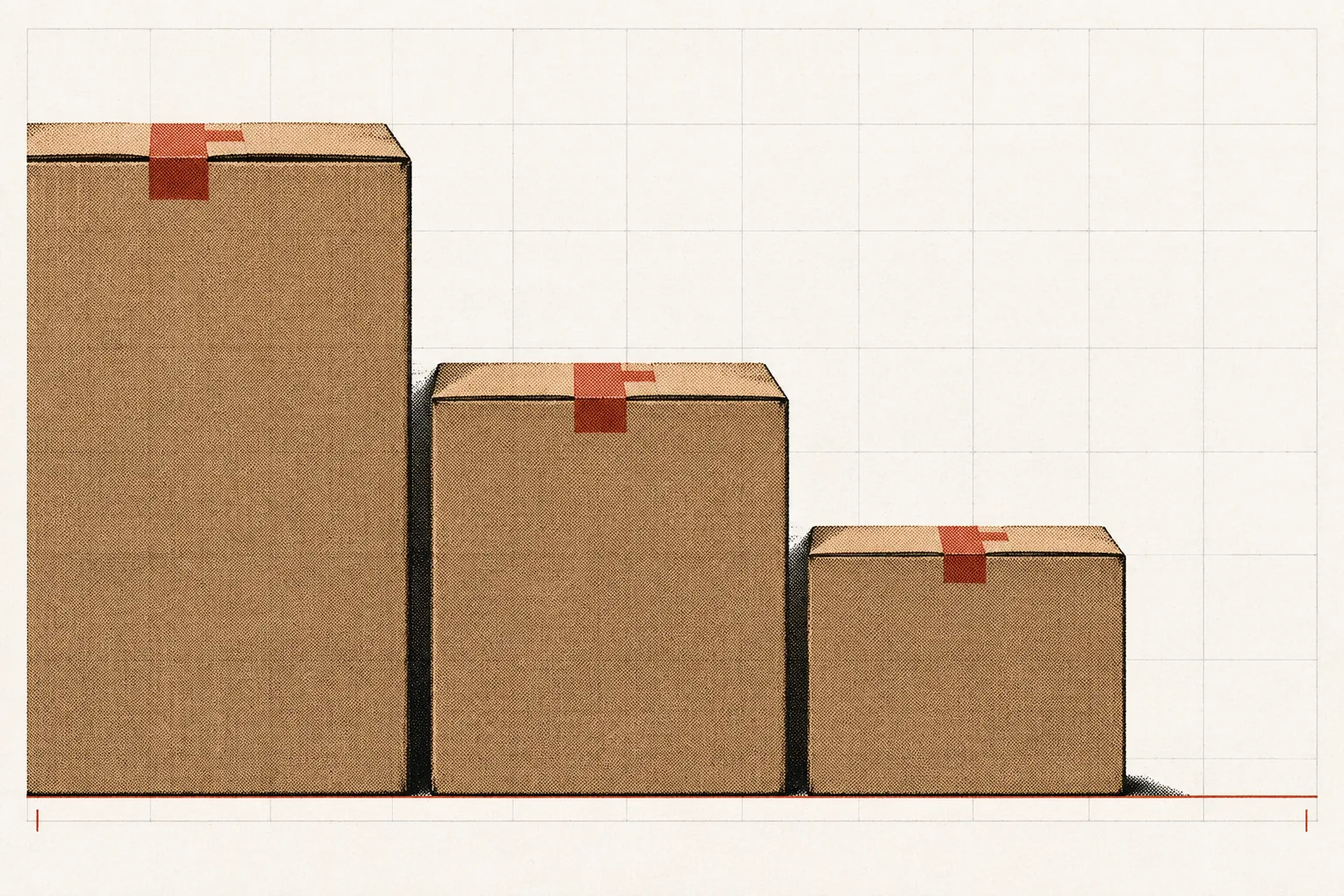
For luggage brand managers and import logistics directors, shipping empty interior volume across ocean trade lanes represents one of the largest controllable landed-cost penalties. In standard ocean freight, a 40-foot high-cube (40HQ) container provides approximately 68 to 76 cubic meters of usable loading space, depending on whether cargo is floor-loaded or palletized. When packing hard-shell luggage—such as 20-inch carry-on, 24-inch medium, and 28-inch check-in sizes—shipping each piece in its own individual corrugated carton means paying ocean freight tariffs primarily on trapped air.
Nesting a three-piece set (inserting the 20-inch inside the 24-inch, which is then housed inside the 28-inch case) collapses three distinct SKUs into the dimensional footprint of a single outer carton. This consolidation substantially multiplies the effective unit payload per container compared to individual box shipments. However, exact piece counts per 40HQ container cannot be calculated using generic volumetric formulas. Finished packaging dimensions depend entirely on the specific shell geometry, wheel base track, handle housing clearance, and whether the container is hand-stacked to maximum ceiling height or palletized for mechanical cross-docking. Exact piece counts are confirmed per order based on verified master carton measurements.
While floor-loading nested cartons maximizes container cubic volume utilization, it introduces operational trade-offs downstream. Sourcing teams must evaluate whether the freight savings generated by nesting offset the handling requirements at destination warehouses, where workers must de-nest, inspect, and potentially re-cartonize individual units prior to retail or direct-to-consumer distribution.
Shell Surface Protection: Multi-Layer Barrier Packaging for Nested Shipments
During multi-week ocean transit, engine vibration and vessel motion induce continuous micro-friction within containerized cargo. In a nested configuration—where a 20-inch cabin case is packed inside a 24-inch mid-size upright, which is subsequently nested into a 28-inch check-in case—the mechanical contact points between shells demand engineered separation. Without targeted barrier layers, rigid elements such as recessed wheel wells, internal trolley housings, and zipper sliders will rub directly against finished exterior shells, causing visible scuffing, gloss burnishing, or scratches on PC/ABS and anodized aluminum frame profiles.
To eliminate abrasive contact, each nested unit is enclosed in a tailored non-woven fabric sleeve before insertion into the host case. For high-gloss finishes or sensitive exterior surfaces, removable polyethylene (PE) protective films are applied to high-contact zones. Structural clearance is maintained by placing custom-cut expanded polyethylene (EPE) foam pads between the caster assemblies of the smaller case and the interior lining of the receiving luggage, isolating the moving components from the host case's internal trolley channel.
Because draft angles, interior capacities, and shell geometries differ across tooling designs, nesting clearances are verified during initial packing trials at our Bogor facility. Specifying the correct combination of foam density, sleeve thickness, and corner blocks ensures the nested assembly remains mechanically stable inside the master carton throughout international ocean freight, preventing cosmetic damage before units reach distribution centers.
Hardware and Wheel Geometry: Nesting Tolerances to Prevent Shell and Lining Damage
When nesting a 20-inch carry-on inside a 24-inch intermediate case, or a 24-inch inside a 28-inch trunk, hardware clearance dictates whether the set arrives intact. Fixed spinner wheel assemblies, side-carry handles, and recessed trolley tube housings create high-pressure contact points against the host luggage’s interior lining. If the dimensional gap between the outer unit's internal ribs and the inner unit's external hardware falls below critical tolerance, continuous ocean transit vibration transforms these contact zones into puncture hazards.
Dual-caster wheel brackets and corner protectors represent the highest point-load risks. During nesting, protruding caster wheels press directly into the fabric lining and underlying substrate of the outer suitcase. Tooling draft angles and inner cavity dimensions must account for these hardware footprints. To prevent metal rivet heads, aluminum framing joints, and wheel edges from abrading the interior, inner cases are wrapped in non-woven protective sleeves, often reinforced with expanded polyethylene (EPE) caps positioned over the wheel wells before insertion.
Nesting tolerances must also factor in dynamic deflection under container stacking weight. When master cartons are stacked several tiers high inside a 40HQ container, vertical loads transmit through the outer luggage shell. If an inner unit fits too tightly without sufficient clearance around its wheel assemblies, exterior compression forces the outer shell directly against the rigid hardware of the enclosed piece, creating stress cracks in PC/ABS or PP walls. Fitment tolerances, internal padding thickness, and final carton dimensions are evaluated on a per-geometry basis during pre-production sampling rather than standard nominal sizing.
Ocean Freight Savings Versus Downstream 3PL De-Nesting Costs
Consolidating a three-piece luggage set—typically a 20-inch carry-on, 24-inch mid-size, and 28-inch trunk—into a single master carton reduces the aggregate cubic meters (CBM) required in a 40HQ container down to the footprint of the largest shell. Because ocean freight is billed on container capacity rather than gross luggage weight, nested configurations significantly decrease landed shipping costs per unit. Because exact container piece counts depend entirely on shell curvature, wheel caster clearance, and outer packaging calipers, precise load plans must be calculated per project rather than estimated from standard sizing tables.
However, the total landed margin depends heavily on the downstream distribution model. For e-commerce brands selling individual SKUs directly to consumers, nested shipping requires third-party logistics (3PL) facilities to de-nest the product. Warehouse personnel must unbox the master pack, extract the inner suitcases, remove protective non-woven dust covers, conduct visual quality checks, and repack individual units into dedicated e-commerce shipping cartons. This secondary handling introduces warehouse labor charges, additional corrugated material costs, and an extra handling touchpoint where scratch damage can occur.
Conversely, for wholesale distributors, promotional corporate clients, or retail programs selling full luggage bundles, nested master cartons remain the most cost-effective method. Sourcing managers must compare the calculated container ocean freight variance against local 3PL de-nesting and re-cartoning rate sheets. If the domestic warehouse repacking fee per unit exceeds the ocean volume savings gained at origin, ordering factory-packed individual single cartons directly from the production line provides a lower net operating cost.
Factory Nesting Protocols and Export Packing Lead Times in Bogor
At our 10,000 m² facility in Kemang, Bogor, packing configurations are integrated directly into the final assembly stage across our four production lines. For nested sets—typically pairing 20-inch carry-on, 24-inch mid-size, and 28-inch check-in cases—assembly schedules are synchronized so that exterior shells receive inner units immediately following hardware inspection. To prevent interior marring, lining abrasion, and transit scuffs, our 75 production workers install custom-fit non-woven or poly protective bags over each inner shell and insert foam spacers around protruding components, such as dual-caster wheels and side bumpers, before nesting.
Because shell geometries, corner guard profiles, and wheel configurations alter exterior carton dimensions, we do not apply rigid piece-count tables for ocean containers. Instead, our technical team confirms master carton dimensions and exact 40HQ payload capacities on an order-by-order basis. Mass production lead times for nested sets range between 25–55 days following sample sign-off, with an MOQ of 100 pieces per SKU. Sample builds for nested fitting validation require 7–15 working days.
For custom OEM programs requiring dedicated nesting tooling—engineered using our two 1,500-tonne injection moulding machines and in-house mould tooling capabilities—the total development timeline spans approximately 80 days. This includes 10 days for mould production, 25 days for mould transit, and 45 days for initial mass manufacturing. Shipments departing our West Java facility are supported by bilateral trade documentation, including Form D, Form E, RCEP, IJEPA, and ICO certificates, facilitating duty-efficient customs clearance across destination ports in Australia, Germany, the United Kingdom, the United States, and China.